Out of Tune, Out of Mind: How Silent Hill's Broken Music Destroys You From the Inside
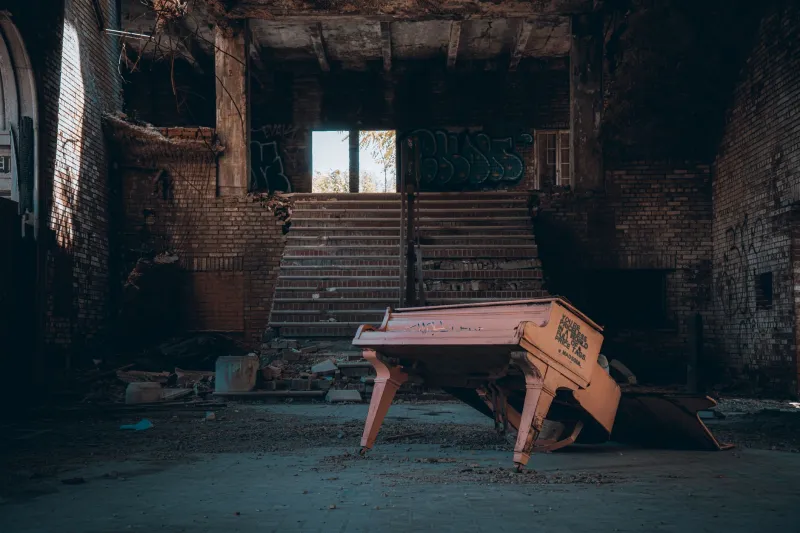
There's a specific kind of wrong that hits harder than anything overtly terrifying. Not a jump scare. Not a monster lurching out of the dark. It's the feeling you get when something almost sounds like music — but doesn't quite make it. Like a lullaby played on an instrument that's slowly dying. Like a melody that forgets its own ending.
That's Silent Hill's secret weapon, and it's been hiding in plain hearing for over two decades.
Most conversations about the franchise's audio design start and end with Akira Yamaoka's genius — and rightfully so. The man is a legend. But the broader conversation tends to focus on atmosphere: the iconic industrial clanging, the brooding guitar lines, the emotional weight of tracks like "Theme of Laura." What gets talked about less is the deliberate wrongness woven through the series at a granular level. The off-key piano notes. The instruments that sound like they're breaking mid-phrase. The melodies that start somewhere recognizable and then quietly, horribly, drift somewhere they were never supposed to go.
This isn't accidental. It's a precision instrument pointed directly at your nervous system.
Why "Wrong" Music Hits Different
Human brains are pattern-recognition machines. We are wired, deeply and evolutionarily, to expect resolution in music — a chord that wants to land somewhere, a melody that follows a logical arc. When that resolution gets denied, or worse, corrupted, the brain doesn't just register confusion. It registers threat.
Musicologists call this phenomenon "sensory dissonance" — the cognitive friction produced when sounds clash in ways that resist resolution. Horror composers have exploited this for decades, from Bernard Herrmann's shrieking strings in Psycho to the atonal chaos of John Carpenter's The Thing score. But most horror music deploys dissonance as a blunt instrument. It arrives, it screams, it leaves.
Silent Hill does something far more insidious. It hides the dissonance inside music that wants you to feel comfortable first.
The Trap of the Familiar
Take "Alone in the Town" from Silent Hill 2. On the surface, it's melancholy and spare — a simple piano figure that feels almost elegiac, the kind of thing you might hear soundtracking a quiet moment in an indie film. But listen closer. The timing is slightly off, like a pianist playing through exhaustion or grief. Notes linger a beat too long. Certain intervals hit and don't resolve the way Western musical training tells your brain they should. It's not chaos — it's controlled wrongness, calibrated to make you feel like something is just slipping out of reach.
That's the trap. The music lures you into an emotional space — sadness, nostalgia, something approaching calm — and then quietly pulls the floor out. You don't even notice it happening until you realize your chest is tight and you can't explain why.
Silent Hill 3 does this even more aggressively. Tracks like "Innocent Moon" wrap genuinely beautiful melodic ideas in production choices that feel slightly degraded, slightly broken — like a cassette tape that's been left in a hot car. The warmth is real, but it's decaying in real time. Heather's story is literally about a young woman whose sense of self is being dismantled, and the music mirrors that at a structural level. The beauty and the wrongness coexist because they have to. One without the other would be dishonest to what the game is actually saying.
Industrial Noise as Anti-Music
The Otherworld sequences take a different approach, but the underlying logic is the same. When Silent Hill's reality tips into its nightmare version, the soundscape abandons melody almost entirely — replacing it with clanging metal, distorted feedback loops, rhythms that feel like machinery running without purpose. This is dissonance at its most extreme: not just music played wrong, but the concept of music being destroyed and replaced with something that functions like music without actually being it.
What's clever here is contrast. Because Yamaoka's team establishes genuine musical warmth in the game's quieter moments, the industrial hellscapes hit harder by comparison. Your brain is constantly measuring the distance between where the audio was and where it is now. That distance — that gap — is where the horror lives.
This technique predates Silent Hill in experimental and noise music circles. Artists like Throbbing Gristle and early industrial acts built entire careers on using sound to produce psychological discomfort. But those scenes were niche by design, aimed at audiences who sought out that experience. Silent Hill smuggled the same toolkit into a mainstream horror game, wrapped in enough conventional melody to lower your defenses before the wrongness moved in.
The Radio as Dissonance Machine
The franchise's radio mechanic deserves a mention here, even though it's been discussed elsewhere. The static that builds as enemies approach isn't random noise — it's a specific frequency of interference that sits in a register humans find instinctively unpleasant. It's not quite white noise, not quite signal, not quite music. It's the audio equivalent of something half-formed, caught between states.
Combined with the ambient soundtrack, the radio creates layered dissonance: the background score doing its quietly wrong thing while the static builds on top of it, both sources competing and clashing in ways that never resolve. By the time something actually appears on screen, your nervous system has already been running a low-grade threat response for the past sixty seconds. The monster almost becomes a relief, because at least it's definite.
Later Entries and What Got Lost
It's worth noting that as the franchise moved away from Yamaoka's involvement — particularly in entries like Homecoming and Downpour — the specific quality of deliberate wrongness in the music changed. Both games have their merits, and Downpour's score by Daniel Licht has real emotional range. But the granular dissonance, the sense of music that knows it's broken and is using that brokenness as language, isn't quite there in the same way.
This isn't a knock on those composers — it's an acknowledgment that what Yamaoka built was genuinely unusual. The dissonance in the classic Silent Hill titles doesn't feel like a stylistic choice layered on top of the music. It feels structural, like the wrongness is load-bearing. Remove it and something essential collapses.
What It All Means
Silent Hill has always been a franchise about the gap between what we want to believe and what's actually true — about characters (and players) confronting versions of reality that won't cooperate with their expectations. The music, at its best, is doing exactly the same thing.
It offers you something that sounds like comfort, something that sounds like beauty, something that sounds like resolution — and then, quietly, it takes it back. Not with a crash or a scream. Just with a note that lands slightly wrong. A melody that trails off somewhere it wasn't supposed to go.
That's the real horror of Silent Hill's audio design. Not the loud parts. The parts that almost sound okay.